

Screens have become an essential part of modern life. We use smartphones to communicate, computers to work, tablets to study, and televisions to relax. Digital devices can make everyday activities easier, but spending too much time looking at screens can also affect different aspects of our health.
The important question is not simply whether screen time is “good” or “bad.” Screens are tools, and their effects depend on how, when, and why we use them. A few hours of productive computer work may have a very different impact from several hours of scrolling social media late at night.
Excessive or poorly managed screen use can contribute to problems such as eye discomfort, poor posture, reduced physical activity, disrupted sleep, and difficulty maintaining healthy routines. 📱
Fortunately, you do not necessarily need to eliminate screens from your life. Small changes in how you use digital devices can make screen time more comfortable and balanced.
👀 What Happens to Your Eyes During Long Screen Sessions?
One of the most common complaints associated with prolonged screen use is digital eye strain.
When looking at a screen for a long time, people may blink less frequently and maintain focus on a nearby object for an extended period. This can contribute to temporary symptoms such as:
- 👁️ Dry or irritated eyes
- 😣 Eye fatigue
- 🤕 Headaches
- 🔎 Difficulty focusing temporarily
- 💡 Increased sensitivity to light
- 👀 Blurred vision
These symptoms are usually related to prolonged visual tasks rather than permanent eye damage from ordinary screen use.
A useful habit is to take regular breaks and look at something farther away.
👁️ Try the 20-20-20 Approach
One commonly recommended strategy is the 20-20-20 rule.
After about 20 minutes of close-up screen work, look at something approximately 20 feet away for around 20 seconds.
The idea is simple: give your eyes a brief change of focus instead of staring continuously at the same nearby screen.
You can also consciously blink more often and adjust screen brightness to a comfortable level.


🪑 Screen Time Can Affect Your Posture
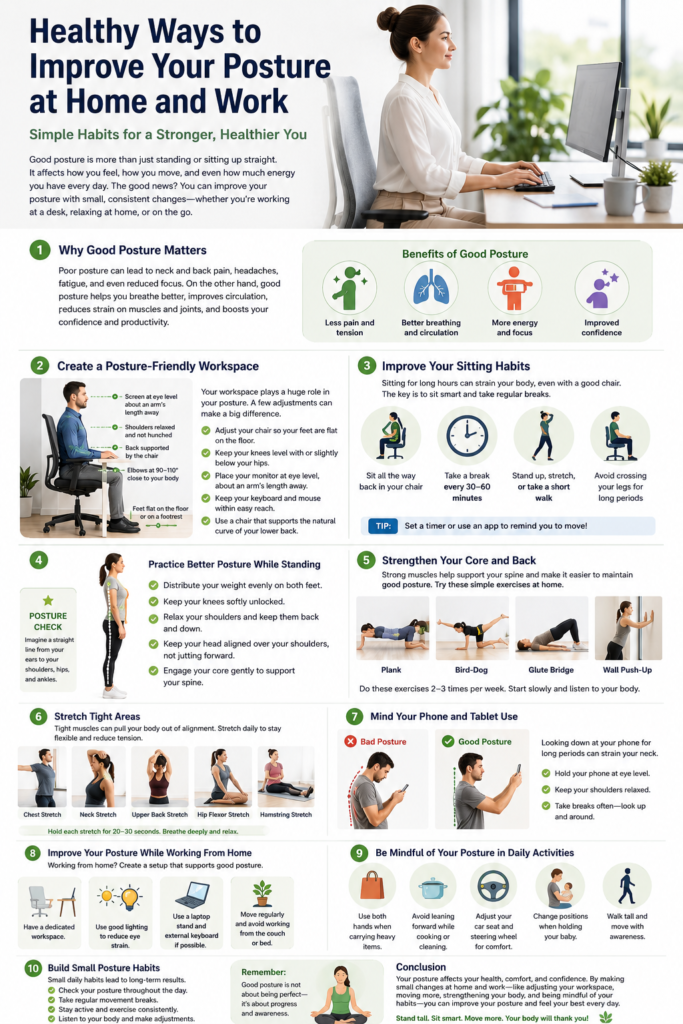
Long periods of sitting in front of a computer or looking down at a smartphone can contribute to poor posture.
A common example is sitting with the shoulders rounded and the head tilted forward toward a screen.
Over time, this position can contribute to discomfort in the:
- Neck
- Shoulders
- Upper back
- Lower back
The problem is often not one particular posture but remaining in the same position for too long.
🧍 Improve Your Screen Setup
If you work at a computer regularly, consider keeping your monitor at a comfortable height so you do not constantly look downward.
Keep your shoulders relaxed, support your lower back, and position your keyboard and mouse comfortably.
Most importantly, get up regularly.
Even a well-designed workstation cannot completely replace movement.
Standing up, walking around, stretching, or changing positions throughout the day can help break up long periods of sitting.
🏃 Excessive Screen Time Can Reduce Physical Activity
One of the biggest indirect effects of excessive screen use is that it can replace physical activity.
Consider a typical evening: someone comes home from work or school, sits down to watch videos, checks social media, plays games, and then spends additional time on their phone before bed.
Several hours can pass with very little movement.
If screen-based activities consistently replace walking, exercise, sports, outdoor activities, or other movement, overall physical activity may decrease.
Regular movement is important for cardiovascular fitness, muscle strength, mobility, metabolic health, and general well-being.
The solution does not have to be eliminating entertainment screens.
Instead, create opportunities to move.
🚶 Take a short walk during breaks.
🧘 Stretch after long periods of sitting.
🏃 Exercise before or after work.
🎵 Listen to music while walking instead of sitting.
🏠 Do household activities that require movement.
Small amounts of movement throughout the day can add up.
😴 Screens Can Interfere With Sleep
One of the most important concerns about excessive screen use is its relationship with sleep.
Using smartphones, tablets, computers, or televisions late at night can make it easier to stay awake longer than intended.
You may tell yourself you will watch one more video, read one more post, or answer one more message—and suddenly another hour has passed. 🌙
Screen use close to bedtime can also provide stimulating content that makes it harder to mentally switch into relaxation mode.
Bright light from screens can also affect the body’s circadian system, although the relationship between screen use and sleep is more complicated than simply blaming “blue light.”
🌙 Create a Screen-Free Wind-Down Period
Try creating a period before bedtime when you reduce stimulating screen activities.
Instead, consider:
📖 Reading a physical book
🧘 Practicing relaxation exercises
🎵 Listening to calm music
📝 Preparing for the next day
💬 Having a quiet conversation
🌙 Keeping the bedroom comfortable and dark
If you use your phone as an alarm clock, consider placing it farther from your bed to reduce the temptation to check notifications.
🧠 Excessive Screen Use Can Affect Mental Well-Being
The relationship between screen use and mental health is complex.
Not all screen time has the same psychological effects.
A video call with a close friend, an online class, a creative project, and endless social-media scrolling are very different experiences.
However, spending excessive amounts of time on highly stimulating or emotionally stressful digital content may contribute to feelings of stress, comparison, distraction, or information overload in some people.
Social media can sometimes encourage people to compare their lives with carefully selected images of others.
Remember that what you see online often represents a small, edited portion of someone’s life.
If you notice that certain digital activities consistently leave you feeling anxious, upset, inadequate, or exhausted, consider reducing your exposure.
🔔 Constant Notifications Can Increase Distraction
Modern devices are designed to keep us connected.
Messages, emails, social-media notifications, news alerts, advertisements, and app reminders can interrupt you throughout the day.
Even when you do not immediately respond, a notification can pull your attention away from what you were doing.
Repeated interruptions can make it harder to maintain concentration.
A simple solution is to reduce unnecessary notifications.
You can:
🔕 Disable nonessential alerts
📵 Use “Do Not Disturb” during focused work
📱 Keep your phone away during important tasks
⏰ Set specific times to check messages
🧠 Avoid checking your phone automatically whenever you feel bored
You do not have to respond to everything immediately.
🍽️ Screen Use Can Affect Eating Habits
Another potential problem is distracted eating.
When people eat while watching videos, scrolling social media, or working on a computer, they may pay less attention to hunger and fullness signals.
This does not mean eating in front of a screen automatically causes unhealthy eating.
However, mindful eating can help you notice what and how much you are consuming.
Whenever practical, try putting the phone away during meals.
Sit down, enjoy your food, and give yourself a few minutes without digital distractions.
Meals can also become opportunities for conversation with family or friends. 🥗
🧒 Children and Screen Time
Children and teenagers deserve special consideration because their routines, development, sleep, physical activity, and social experiences are still developing.
The appropriate amount and type of screen use varies according to age and circumstances.
Parents and caregivers can focus not only on the number of hours but also on what children are doing on screens and what screen use is replacing.
Ask:
- Is the child getting enough sleep?
- Are they physically active?
- Are they spending time with family and friends?
- Are screens interfering with schoolwork?
- Are they eating regular meals?
- Are they able to participate in hobbies and outdoor activities?
Instead of relying only on strict bans, families can establish reasonable boundaries.
For example, certain areas of the home can be screen-free, such as the dining table.
A consistent bedtime routine can also help reduce late-night device use.


🎮 Gaming and Long Sitting Sessions
Video games can provide entertainment, social connection, and even opportunities for problem-solving.
The concern arises when gaming sessions become so long that they interfere with sleep, physical activity, education, work, meals, or relationships.
If you enjoy gaming, consider building movement into your routine.
Take breaks between sessions.
Stand up, stretch, drink water, and walk around.
Motion-controlled games can provide some physical activity, but they should not necessarily be considered a complete replacement for regular exercise.
The goal is balance.
💻 Work-Related Screen Time Is Different
Many people cannot simply reduce their screen time because their job requires computers.
Office workers, students, designers, programmers, healthcare professionals, business owners, and many other people may spend significant portions of the day using digital devices.
In these situations, the goal should be healthy screen habits, not eliminating screens.
Consider:
- 🪑 Improving your workstation
- 👀 Taking regular visual breaks
- 🚶 Getting up frequently
- 💧 Keeping water nearby
- 🧘 Stretching during breaks
- 🌙 Disconnecting from work after working hours
- 🔕 Reducing unnecessary work notifications
Even small adjustments can make long workdays more manageable.
📱 Smartphones and the Habit of Constant Checking
One of the unique challenges of smartphones is their availability.
A computer is usually sitting on a desk. A smartphone can remain in your pocket all day.
This makes it easy to check your device dozens or hundreds of times without consciously deciding to do so.
You may reach for your phone while waiting for an elevator, standing in line, sitting on public transport, eating, or even talking to someone.
Try introducing periods when your phone stays out of reach.
For example, keep it in another room while reading, exercising, eating, or spending quality time with family.
You may initially feel uncomfortable, but over time you can become less dependent on constant checking.
📵 Try a Digital Detox
A “digital detox” does not have to mean disappearing from the internet for a week.
For most people, smaller changes are easier to maintain.
Try a one-hour screen-free period each evening.
You could also designate one meal per day as screen-free.
Another option is a weekend morning without social media.
The goal is not to fear technology.
It is to regain control over when and how you use it.
⏱️ Set Screen-Time Limits
Most modern smartphones provide tools that allow you to see how much time you spend on different apps.
Checking this information can be surprisingly useful.
You may discover that a few minutes of scrolling here and there adds up to several hours each week.
Instead of immediately trying to cut your total screen time dramatically, identify one activity that is taking more time than you would like.
You might reduce social-media use by 30 minutes a day or stop watching videos during the hour before bedtime.
Small, measurable goals are often easier to maintain.
🌳 Replace Screen Time With Real-World Activities
Simply saying “use your phone less” can be difficult because it does not answer an important question:
What will you do instead?
Create a list of alternatives.
🚶 Go for a walk.
📚 Read a book.
🎨 Try a creative hobby.
🍳 Cook a meal.
🌱 Work in the garden.
🏸 Play a sport.
🎵 Listen to music.
👨👩👧 Spend time with family.
☕ Meet a friend.
🧘 Practice relaxation.
Having alternatives makes reducing screen time feel less like giving something up and more like gaining time for other activities.
🛏️ Keep Screens Out of the Bedroom When Possible
The bedroom should ideally be associated with rest and sleep.
If you regularly scroll through social media, watch videos, or answer work messages in bed, your brain may begin associating the bedroom with activity rather than relaxation.
Try creating a technology-free bedtime routine.
Charge your phone away from the bed if practical.
If you need your phone for emergencies, use appropriate settings that allow important calls while silencing unnecessary notifications.
👁️ Make Screens More Comfortable
If you have to use screens for long periods, make the experience more comfortable.
Adjust the brightness to match your environment.
Increase text size if you frequently strain to read.
Keep the screen at a comfortable viewing distance.
Reduce glare from windows or overhead lights.
Remember to blink regularly.
Most importantly, take breaks.
Comfortable screen use is about reducing strain, not making prolonged screen exposure completely harmless.
🧘 The Goal Is Balance, Not Perfection
Technology is not going away—and it does not need to.
Screens help us learn, work, communicate, create, exercise, shop, navigate, and stay connected.
The problem occurs when digital activities consistently interfere with essential aspects of a healthy lifestyle.
Rather than asking, “How many hours of screen time are allowed?” consider asking:
Is my screen use interfering with sleep, exercise, relationships, work, study, or other activities that matter to me?
That question can provide a more useful starting point.
✅ A Simple Daily Screen-Time Plan
Here is an easy routine you can experiment with:
🌅 Morning: Avoid immediately checking social media after waking.
💻 Work/study: Take regular breaks and change your position frequently.
🥗 Meals: Keep screens away when possible.
🚶 Afternoon: Add physical movement between long screen sessions.
🔕 Evening: Turn off unnecessary notifications.
📱 Before bed: Reduce stimulating screen activities.
🌙 Night: Keep your bedroom focused on sleep and relaxation.
You can adapt this routine to your lifestyle.
📋 Screen-Time Health Checklist
Use this checklist to evaluate your current habits:
☑️ Do I take regular eye breaks?
☑️ Do I change position throughout the day?
☑️ Do I get enough physical activity?
☑️ Do screens interfere with my sleep?
☑️ Do I check my phone automatically?
☑️ Are notifications distracting me?
☑️ Do I use screens while eating?
☑️ Do I spend enough time outdoors?
☑️ Do I have regular screen-free periods?
☑️ Do I have a relaxing bedtime routine?
If several answers concern you, choose one or two areas to improve first.
You do not have to change everything at once.
🌟 Conclusion
Screens are an important part of modern life, but excessive or poorly managed screen use can affect several aspects of health and daily well-being.
Long periods of screen use may contribute to eye strain, sedentary behavior, poor posture, sleep disruption, distraction, and reduced time for physical activity or face-to-face interaction.
The solution is not necessarily to eliminate technology.
Instead, aim for healthy digital habits.
Take regular breaks, move your body, protect your sleep, reduce unnecessary notifications, create screen-free periods, and pay attention to how digital activities affect your mood and daily routine.
Most importantly, remember that screen time is not all the same. An online class, eight hours of work, a video call with family, and several hours of passive scrolling have different purposes and experiences.
The healthiest approach is to use technology intentionally rather than automatically.
Put your phone down when you do not need it. Look away from the screen. Go outside. Move your body. Talk to someone. Read a book. Get enough sleep. 🌿
Your devices should support your life—not take over the time you need for your health.
Disclaimer: This article is for general educational purposes and is not a substitute for personalized medical advice. If you experience persistent eye problems, significant sleep difficulties, ongoing pain, headaches, or other concerning symptoms, consult an appropriate healthcare professional.